
You’re probably not here because things are crystal-clear for your SaaS.
You’re here because growth has stalled, a launch is coming up, or you’ve been burning money on tactics that aren’t converting and you need someone who actually knows SaaS to tell you why.
Maybe you threw “SaaS GTM agency” into Claude and got a list of firms you’ve never heard of, with no context for which ones are worth your time and money and which ones are going to hand you a 60-slide strategy deck and disappear. This guide is an attempt to fix that.
I’ve spent years working with SaaS founders on their go-to-market strategy, and I refer a lot of founders to outside help. Not because DemandMaven can’t help (we can), but because the right partner depends entirely on where you are, what you actually need, and whether you’re ready for what a specific kind of firm delivers. We’ll cover a little bit of that, too.
What is a go-to-market strategy, and what does a GTM agency actually do?
A go-to-market strategy is the plan for how you bring your product to market and generate revenue from it. That sounds simple, but it touches almost every part of your business: who you’re selling to, how you’re positioning the product, what you’re charging, and which channels you’re using to acquire customers.
The best mental model I know for thinking about this comes from Brian Balfour’s Four Fits framework.¹ Balfour breaks GTM down into four interconnected quadrants:
Product: What you’re building and the value it delivers to a specific customer.
Market: The specific set of people who have the problem your product solves, and who are willing and able to pay for it.
Model: How you price, package, and monetize the product, including your revenue model (subscription, usage-based, freemium, etc.).
Channel: How you actually reach and acquire customers, from SEO and paid search to sales, partnerships, and word of mouth.
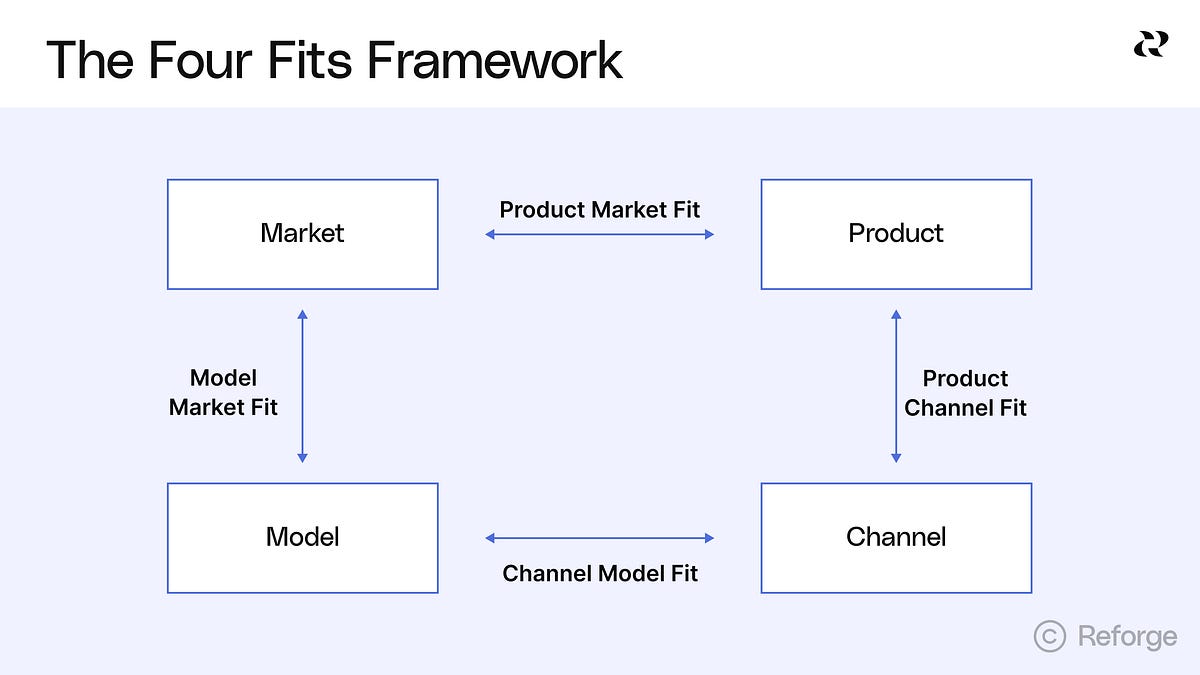
What makes this framework so useful is the word “fit.” These four things have to fit each other: your channel has to fit your model, your model has to fit your market, your market has to fit your product. When one is off, all of them suffer. And when founders think they have a “marketing problem,” they often actually have a model or market problem they haven’t diagnosed yet.
GTM agencies and consultants help you figure out which quadrant is broken, define each one clearly, and execute against it. The challenge is that “GTM agency” is a term that gets used to describe wildly different things, so understanding the two main flavors before you go looking is worth a few minutes of your time.
Two types of GTM help: execution vs strategy
This is the distinction that most lists skip entirely, and it’s the one that matters most.
Type 1: Execution agencies
Execution agencies do the actual marketing work: running paid ads, building SEO content programs, managing ABM campaigns, writing emails, building demand generation engines. When founders say “I need to hire an agency,” this is usually what they mean.
The thing execution agencies are not designed to do is figure out your strategy for you. They’re expecting you to show up with a clear ICP, defined positioning, and a product that’s already converting and retaining customers at a reasonable rate. If those things aren’t in place, you will spend a lot of money running efficient campaigns to the wrong people, and the agency will not always tell you that’s the problem.
You’re ready for an execution agency when:
- You have a clear, validated ICP and know which segments you’re targeting
- Your product is converting free trials or demos to paid at a healthy rate (ideally 20%+ for trials, or a demo-to-close rate your sales team can sustain)
- Your net revenue retention is at least stable, ideally growing
- You have meaningful budget to invest: execution agencies typically require at least $50K per year to be effective, and some of the best firms want significantly more than that
- You want speed and scale, not diagnosis
Type 2: Strategic GTM consultants
Strategic consultants are for when you’re not yet sure which execution plays to invest in. They help you answer questions like: who are my best customers, why do they buy, what’s my positioning, which channels are actually worth investing in, and is my pricing working against me?
DemandMaven sits in this category. So do Forget the Funnel and a handful of others listed below. Strategic consultants are slower and less “exciting” than an agency that’s promising you pipeline, but for founders at the wrong stage, hiring an execution agency before doing this work is one of the most expensive mistakes I see.
You need a strategic consultant when:
- You’re not sure who your best customers actually are
- Your positioning and messaging feel off but you can’t articulate why
- You’ve tried execution (ads, content, outreach) and it hasn’t worked the way you expected
- Your activation or retention is low and you suspect it’s a product-market fit or messaging problem
- You’re pre-revenue or early-revenue and about to make big bets on GTM
- You’ve changed pricing and noticed unexpected churn
- You’ve made assumptions about your market and would love to battle-test them
- You’ve never actually talked to your target market and it shows
A word of caution regarding marketing agencies
It’s really really common for marketing agencies to claim that they do “GTM strategy”, but it’s really important that you understand that most marketing agencies will never inform your actual GTM strategy for your business.
What marketing agencies are actually doing is called “channel strategy” which is certainly part of GTM, but not the whole story.
When you talk to marketing agencies, get really clear on exactly what level of GTM strategy they’re actually contributing to. If you’re hoping for feedback on your PLG strategy, which GTM motion you should be using, your approach to pricing, or perhaps most important — what features you should prioritize and which customers to target, you’re going to be very disappointed to find most marketing agencies can’t and won’t help you refine these elements.
I cannot tell you how many tells I’ve talked to founders who’ve been burned in the past and dropped way too much money on marketing execution when they weren’t actually ready, so it’s important you get super clear on what your needs are.
But if you have all of those things somewhat sorted, then it makes sense to focus on channel execution. Okay, rant over. Let’s get into the list!
Top SaaS GTM execution agencies
1. Kalungi
Best for: B2B SaaS companies at early-to-mid growth stage that need a full outsourced marketing team, not just a single service
Kalungi is one of the few execution agencies I recommend regularly because they’re genuinely full-service and exclusively focused on B2B SaaS. They’re not trying to also run campaigns for e-commerce brands or local businesses. Their entire playbook was built for software companies.
Their model combines fractional CMO leadership with hands-on execution across demand generation, content, SEO, paid acquisition, ABM, marketing automation, and sales enablement. The fractional CMO sits inside your business like a real marketing leader, not a consultant who shows up for two calls a month. This is particularly useful for founders who need executive-level marketing direction but can’t yet justify a full-time CMO hire.
Kalungi operates on what they call the T2D3 framework (triple, triple, double, double, double), which is a growth trajectory model designed to help SaaS companies scale toward meaningful ARR milestones. Their case studies include cutting sales cycles from six months to 45 days for one client through better ICP clarity and messaging, and driving $2M in qualified pipeline for another.
Retainers start around $4,000–$15,000 per month depending on scope, with full-service engagements running higher. Kalungi is a good fit when you’re ready to invest in execution and want a team that understands SaaS metrics.
2. Refine Labs
Best for: Mid-market to enterprise B2B SaaS ($20M+ ARR) that’s ready to move away from MQL-based lead generation and commit to a demand creation model
I don’t know Refine Labs personally, but their reputation in the B2B SaaS demand generation space is as strong as it gets. Founded by Chris Walker, they essentially created (or at least popularized) the modern “demand creation” playbook: ungated content, dark social strategy, self-reported attribution, and a hard shift away from counting MQL volume as success.
They’ve worked with 300+ mid-market and enterprise B2B SaaS companies, and the consistent feedback is that they change how leadership teams think about marketing measurement, not just what they execute.
The honest caveats: they’re expensive, they work best with companies that have mature marketing leadership and budget to match, and adopting their model requires genuine organizational buy-in to change how marketing is measured. Full-service management starts at $20,000 per month, and their strategy and assessment project starts at $35,000. If you’re pre-$10M ARR, you’re probably not the right fit yet. If you’re $20M+ ARR and your demand gen approach feels outdated, they’re worth a serious conversation.
3. 42 Agency
Best for: Sales-led B2B SaaS companies that need ABM, demand generation, and RevOps infrastructure built at the same time
42 Agency is run by my friend Kamil Rextin, and it’s one of the firms I recommend most often when a founder is sales-led and ready to build a more systematic demand generation engine. Kamil has deep roots in tech (Uberflip, CrowdRiff), and his approach is more operator-minded than most agency founders: he experiments, he measures, and he’s skeptical of whatever is trending unless the data supports it.
Their sweet spot is companies that need paid media, performance creative, SEO, direct media buys, RevOps, and ABM working as an integrated system rather than as separate vendors doing separate things. They’ve worked with companies like ProfitWell, Sprout Social, and Knak.
If you’re sales-led, targeting enterprise accounts, and need account-based marketing infrastructure that your sales team will actually use, 42 Agency is one of the best places to start. They’re particularly strong for companies where sales and marketing alignment is a real problem (which is most of them, if we’re being honest).
4. Powered by Search
Best for: B2B SaaS companies with high ACV, long sales cycles, and a buyer committee: specifically when search, content, and paid are the primary acquisition levers
Powered by Search, founded by Dev Basu, is a B2B marketing agency I know well and recommend when founders are ready to invest in search-led and inbound customer acquisition. Dev is sharp, and the team has built genuine depth in the SaaS space over more than a decade.
Their “Predictable Growth” methodology focuses on combining paid media, SEO, and demand generation into a system that compounds over time rather than treating each channel as a separate campaign. They’re particularly well-suited for companies with high ACV (think $50K to $500K+) and longer sales cycles, where the buyer journey is complex and positioning clarity matters a great deal for ad and content performance. Clients include Varonis, Fortra, and Collibra.
One important note from the brief: Powered by Search is primarily a marketing agency with GTM capabilities, not a GTM strategy firm. They’re excellent when you’ve already done the strategic work (ICP, positioning, messaging) and are ready to scale acquisition through search and paid channels. If the strategy work isn’t done yet, that’s the wrong order of operations.
5. Conversion Factory
Best for: Early-stage SaaS founders who need product marketing, website execution, and design without hiring a full team
Conversion Factory is a product marketing agency with a subscription-based model that’s unusually accessible for early-stage companies. Their team covers product marketing, conversion rate optimization, Webflow development, and design: essentially the execution you need to make your website and messaging actually work.
What makes them worth including here is speed and flexibility. They work like a productized service: you submit requests, they execute. One founder’s testimonial mentions that Conversion Factory overhauled their website in time for a CNN press release, capturing 10x more leads in one weekend than they had in the entire year prior. For founders who need to move fast without hiring or managing multiple vendors, that model has real appeal.
They skew toward PLG and early-stage teams that ship fast and iterate quickly. If you need deep strategic positioning work, they’re not the right fit for that. But if your positioning is settled and you need execution: product marketing, messaging copy, website redesigns, they’re one of the most efficient ways to get that done.
6. Directive Consulting
Best for: B2B SaaS companies at $5M+ ARR where paid media is a primary acquisition channel and CAC efficiency is the core goal
I haven’t personally worked with or referred clients to Directive Consulting, but their reputation in the SaaS performance marketing space is strong and their positioning is worth noting. Their “Customer Generation” methodology is built around CAC and LTV rather than raw lead volume, which is the right framing for SaaS. They work exclusively with SaaS and tech companies and apply that focus throughout their measurement and strategy approach. Worth exploring if paid media is your primary channel and you want a team that thinks in SaaS metrics.
7. Omniscient Digital
Best for: B2B SaaS companies where organic search is a core acquisition strategy and content needs to function as a full demand generation engine, not just a traffic play
Omniscient Digital is a content marketing and SEO agency that works specifically with B2B SaaS companies. I haven’t worked with them directly, but they’re frequently mentioned alongside the best in this category. If organic search is central to your acquisition strategy and you need a team that can build a content engine (not just produce articles), they’re worth a look. Clients include HubSpot, Jasper, and Hotjar.
8. Hey Digital
Best for: PLG SaaS companies where paid media needs to support trial and self-serve conversion rather than just top-of-funnel awareness
Hey Digital focuses on paid media for SaaS, primarily LinkedIn and Google. I haven’t referred clients to them personally, but their approach stands out from generalist paid agencies: they bring structured experimentation methodology to paid channels rather than just managing budgets. For PLG companies specifically, where paid media often supports trial and self-serve conversion rather than sales pipeline, their approach tends to be a better fit than firms that primarily optimize for MQLs.
Top SaaS GTM consulting firms
1. DemandMaven
Best for: SaaS founders under $10M ARR who need to figure out what their GTM strategy should be before investing in execution
DemandMaven is my firm (here’s my shameless plug). But I’m an open book about who we’re a good fit and who we don’t serve as well.
We don’t do execution. We don’t run campaigns, manage ads, or write your content calendar. Our job is to help you figure out what you should actually be doing before you spend money doing it. That means understanding your best customers through research, clarifying your positioning and messaging, identifying which acquisition channels are actually worth investing in, and making sure your growth strategy is based on your actual business (your team, your budget, your retention, your product) rather than a generic SaaS playbook.
We work with SaaS companies from pre-revenue through roughly $10M ARR, across both GTM-stage engagements (for early-stage founders who need to define their market and messaging) and Growth Engagements (for companies past initial traction who are trying to unlock the next level of growth). We also do SaaS pricing strategy, activation and onboarding strategy, and JTBD customer research as standalone engagements.
The reason founders come to us before hiring an execution agency is usually one of three things: they’re not sure their positioning is right, they’re not sure which channel to invest in, or they’ve hired an agency before and it didn’t work and they want to understand why. All three are signs that the strategy work hasn’t been done yet, and that’s exactly what we exist for.
2. Forget the Funnel
Best for: B2B SaaS teams that need product marketing strategy rooted in deep customer research, especially if messaging and retention are the core problem
Forget the Funnel was co-founded by Gia Laudi and Claire Suellentrop, and it’s one of the firms I recommend most often when a founder’s problem is specifically product marketing: positioning, messaging, retention-linked marketing, and understanding why customers are (or aren’t) staying.
Gia developed the Customer-Led Growth framework, which is rooted in a core belief that nearly every growth challenge can be solved by understanding your best customers more deeply: their jobs to be done, their decision-making process, the language they use, and the moments that made them valuable customers in the first place. She and Claire co-authored the book Forget the Funnel, which has sold 25,000+ copies and has a foreword from Bob Moesta, one of the co-architects of the Jobs-to-be-Done framework. That’s not a casual collaboration.
Gia runs Forget the Funnel as a deliberately small boutique firm. She’s an advisor to SparkToro, Sprout Social, and MarketerHire, among others. If product marketing is your gap, specifically the kind that’s connected to retention and expansion rather than just acquisition, she’s one of the best in the space.
3. April Dunford (Ambient Strategy)
Best for: B2B SaaS and tech companies that need to nail their positioning before anything else: messaging, website, sales pitch, or channel investment
April is a friend, and while we haven’t had the chance to work together directly, I’ve seen her work up close and it’s excellent. She’s the author of Obviously Awesome and Sales Pitch, and the founder of Ambient Strategy. She has worked with over 200 companies including Google, IBM, Postman, and Epic Games, and her positioning methodology is one of the most widely cited frameworks in SaaS.
Her core argument is that positioning is the foundation everything else in GTM is built on: your messaging, your sales pitch, your homepage, your channel strategy. Get it wrong and all the execution in the world won’t fix it. Get it right and the rest becomes considerably cleaner.
Her consulting work is structured around facilitated workshops that align your executive team around a shared, well-tested positioning thesis and a sales pitch that flows from it. These aren’t theoretical exercises: they’re designed to produce decisions your team can act on. If your product is hard to explain, if your sales team is struggling to articulate differentiation, or if your homepage isn’t landing, positioning is almost always where the problem starts. April is one of the best people in the world to fix it.
4. FletchPMM
Best for: Early-stage B2B SaaS startups that need to clarify their positioning and put it to work on their homepage
FletchPMM was co-founded by Anthony Pierri and Robert Kaminski, and I know both of them. They’ve built a genuinely impressive reputation in a very specific niche: helping early-stage B2B software companies sharpen their positioning and translate it directly into a homepage that converts. They’re also particularly approachable for founders who don’t have massive budgets, which makes them a rare find in the positioning consulting space.
Their whole thesis is that the homepage is where positioning theory meets practical reality. You can have a great positioning document and still have a homepage that confuses visitors, because turning a positioning thesis into clear, specific copy requires a different skill set than developing the thesis itself. They’ve helped 400+ B2B software startups work through this, and their frameworks are shared widely on LinkedIn where they’ve built a combined audience of over 130,000 followers, almost entirely through publishing useful thinking rather than ads.
Their scope is narrow by design: they focus on positioning and homepage messaging, not full-stack GTM. That narrowness is a feature, not a limitation. If you’re an early-stage founder whose positioning is fuzzy and whose homepage is trying to say too many things to too many people, FletchPMM is one of the most targeted ways to fix that specific problem.
5. Maja Voje (GTM Strategist)
Best for: Founders who need a structured, research-backed GTM framework and want to build the strategy themselves rather than fully outsource it
Maja Voje is the author of Go-To-Market Strategist, a comprehensive handbook for founders and growth leaders navigating GTM for the first time or resetting after a failed launch. I haven’t worked with her directly, but her book has earned serious credibility in the community: it includes 135 frameworks and 17 workshop templates, and draws on interviews with over 50 GTM practitioners from companies like HubSpot, Miro, Figma, and Amplitude.
Her background spans 11 years across Google, Rocket Internet, and 350+ startups. Her consulting and bootcamp work is especially relevant for founders who want to build real GTM competency internally rather than fully rely on an outside firm. If you’re at an early stage, budget-constrained, and trying to develop your own GTM thinking rigorously rather than just hiring out, her book is one of the most useful resources available, and her GTM Bootcamp engagements extend that thinking into live, facilitated work.
Her framing on product-market fit as a moving target (rather than a box you check once and move on) is particularly useful for founders who feel like they’ve found PMF but can’t figure out why growth has plateaued.
How to compare and choose the right partner
There’s no universal “best” firm here. The right one depends on where you are.
A few questions to work through before you start making calls:
Have you done the strategy work? If you’re not confident in your ICP definition, your positioning, or which channels should be your primary investment, do the strategy work first. Hiring an execution agency before that is expensive and usually disappointing.
What’s your retention and activation telling you? If your net revenue retention is under 60% after 12 months, or your free trial to paid conversion rate is significantly below 20%, those are signals that more top-of-funnel investment will just accelerate churn. Fix the product and retention story first.
What’s your actual budget? Good execution agencies require real investment to be effective. If you have $3,000–$5,000 per month for an agency, that will buy you a small scope of work. If you’re expecting a full-service demand generation program, you need significantly more (think like $15,000 per month not including additional spend). Be honest about this upfront.
Do you need a generalist or a specialist? For ABM and sales-led: 42 Agency. For search-led inbound: Powered by Search. For full-stack SaaS marketing with fractional leadership: Kalungi. For demand creation at scale: Refine Labs. For product marketing and customer-led strategy: Forget the Funnel. For positioning specifically: April Dunford or FletchPMM (the latter especially for early-stage homepage clarity). For building your own GTM strategy with structure: Maja Voje’s book and bootcamps. For early-stage GTM clarity across the full picture before any of the above: DemandMaven.
FAQs
What should I look for in a SaaS GTM agency?
Relevant SaaS experience is table stakes: you don’t want a firm learning your business model on your dime. Beyond that, look for clear thinking about which stage and problem they’re best suited for, a willingness to tell you if they’re not the right fit, and a methodology you can actually understand. Be wary of agencies that lead with case studies about their biggest clients rather than their most relevant clients.
How do I measure the effectiveness of my SaaS marketing strategy?
It depends on which part of the funnel you’re measuring. For acquisition, the most useful signal is qualified traffic and conversion rate to trial or demo, not raw impressions or clicks. For activation, track free trial to paid conversion rate and time-to-value. For retention, net revenue retention at 12 months is the single most honest metric for how your GTM strategy is landing with the right customers. If NRR is strong, your GTM is probably working. If it’s weak, something in the customer profile, positioning, or product experience is off.
When is it too early to hire a GTM agency?
If you haven’t validated your ICP with real customer interviews, if your positioning shifts every time you talk to a new prospect, or if you’re not converting a meaningful percentage of trials or demos to paid customers, it’s too early. Agencies can’t fix product-market fit problems by running better ads. Get the customer discovery work done first.
Not sure where you actually are in this process? Book a free 45-minute discovery call with DemandMaven and we’ll give you an honest read on your biggest growth opportunities.
¹ Brian Balfour’s Four Fits framework: reforge.com/essays/four-fits-growth-framework