
I’ve noticed a pattern with companies that get stuck between $3M and $5M in ARR.
They’re doing well enough to have real traction. They’ve found product-market fit. They’re generating meaningful revenue. But when it comes time to push through to $10M and beyond, they hit a wall.
Most founders assume the problem is they need more people. More engineers, more marketers, more salespeople. Just scale the team and the revenue will follow, right?
Not quite.
The companies that successfully break through this stage aren’t just adding headcount. They’re making fundamental changes to how they’re structured, how they hire, and how they operate. And if you can’t or won’t make those changes, you’ll stay stuck.
The flat org trap
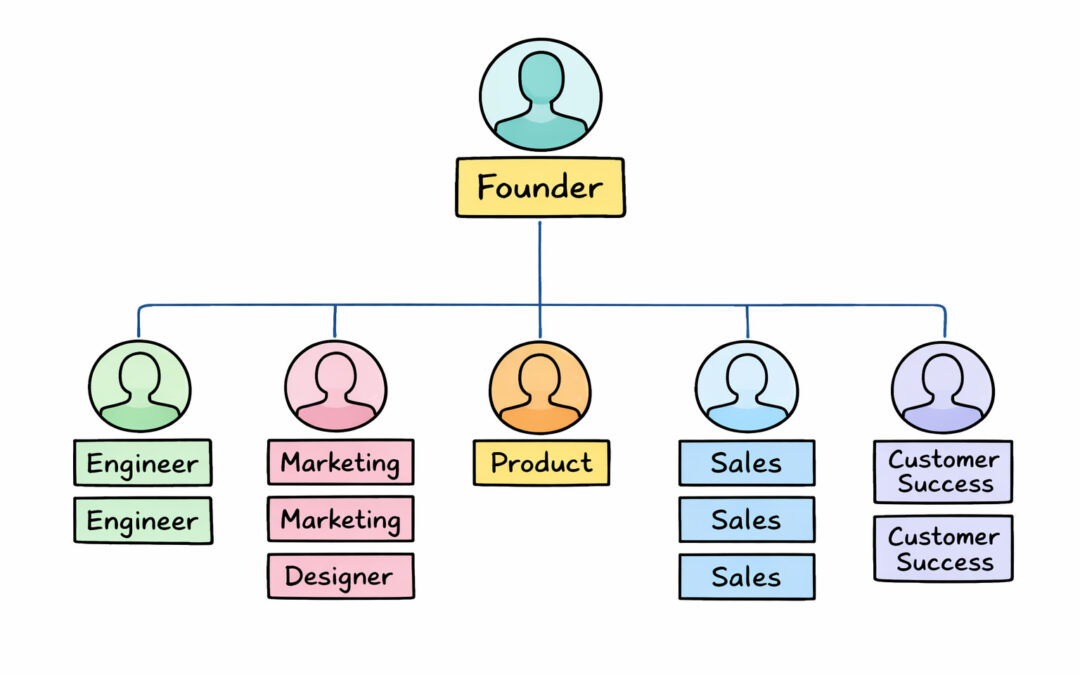
Here’s something I see all the time – CEOs who end up with 15, 18, sometimes 20 direct reports.
It happens gradually. You hire a head of marketing. Then you hire a head of sales. Then you need someone for product, someone for engineering, someone for customer success. Before you know it, you’re managing an entire company as individual direct reports, and it’s absolutely not sustainable.
I had a client who was at about $3M in ARR with 12 direct reports. Every single person was really good at their job, but every single person also needed some form of management, coaching, or guidance. The CEO was spending all their time in one-on-ones and had zero bandwidth to think strategically about where the company needed to go.
This is the flat org trap.
What’s missing is that middle layer. You need people who can manage managers. People who can build teams. People who have experience taking a function from scrappy startup to actual department with processes and systems.
And I think this is a really hard concept for first-time CEOs and founders to wrap their minds around because when you’re small, flat feels right. But when you’re trying to scale, flat becomes your bottleneck.
The three types of debt blocking growth
When I’m diagnosing why a company is stuck, I’m usually looking for one of three types of debt:
1. Analytics debt
You have no idea what’s working because you don’t have the data infrastructure to tell you. You can’t see your funnel clearly. You don’t know which channels are actually driving revenue. You’re making decisions based on gut feel instead of data.
This is incredibly common. Companies prioritize building features over building their analytics stack, and then they get to $3M and realize they’re flying blind.
2. Technical debt
Your product works, but it’s held together with duct tape. You’ve got bugs that have been sitting in the backlog for months. Your engineering team is spending all their time putting out fires instead of building new capabilities. You can’t ship fast enough to keep up with what the market needs.
Technical debt isn’t just an engineering problem. It’s a growth problem. If you can’t iterate quickly, you can’t respond to what your customers are asking for.
3. Leadership debt
This is the big one. You don’t have the experienced talent you need to actually build the thing that will take you to the next stage.
Your team is full of people who are great at execution but have never built a system before. They’ve never hired a team. They’ve never implemented processes at scale. And now you’re asking them to do all of that while also doing their day job, and it’s not working.
Leadership debt is what happens when you optimize for cost instead of capability. You hire junior people because they’re cheaper, and then you wonder why you’re not moving faster.
Experienced talent costs more, but you need it anyway
Let’s talk about the thing nobody wants to hear.
If you can’t afford to hire experienced talent, you’re probably not ready to grow to $10M.
I know that sounds harsh. But the reality is the thing that’s actually preventing you from growing is not having people with the right experience to build what you need.
Experienced people cost more because they’ve already made the mistakes. They know what good looks like. They can come in and set up systems and processes without you having to hold their hand through every step.
When you hire junior people, you’re essentially paying for their education. You’re hoping they’ll figure it out as they go. And sometimes they do. But it’s slow, and it’s painful, and it often means you’re leaving growth on the table while they’re learning.
I’m not saying you need to hire VPs for every function. But you do need people who have done this before. People who can look at your business and say, “Okay, here’s what we need to build, here’s the sequence we need to do it in, and here’s what the next 12 months looks like.”
That’s the difference between spinning your wheels and actually breaking through.
The founder-to-CEO transition nobody talks about
One of the most uncomfortable truths about this stage is that it requires the founder to change.
You can’t keep operating like you did when you were 10 people. You can’t be involved in every decision. You can’t review every piece of work. You have to start trusting other people to make decisions without you.
And that’s hard. Especially if you’re the one who built the product, who found the first customers, who set the culture. Letting go feels like losing control.
But if you don’t let go, you become the bottleneck. Your team can only move as fast as you can review their work. Your company can only grow as much as you can personally manage.
I see this with founders all the time. They say they want to scale, but they’re not willing to actually step back and let their team run things. They want to hire experienced people, but then they micromanage them because they don’t trust anyone to do it as well as they would.
But if you’ve hired the right people, they don’t need you to do their job for them. They need you to set the strategy, give them the resources, and get out of the way.
That’s what it means to transition from founder to CEO.
What it actually takes to break through
So if you’re stuck at $3M or $5M and you want to get to $10M, here’s what you need to do:
Build that middle layer of leadership. Hire people who can manage teams and build systems. Stop collecting direct reports and start building an actual org structure.
Pay down your debt. Whether it’s analytics, technical, or leadership debt, you need to address it. You can’t just keep piling on more features or more people and hope it fixes itself.
Invest in experienced talent. Yes, it costs more. But the alternative is staying stuck or growing so slowly that you miss your window.
And most importantly, be honest with yourself about whether you’re actually ready to make these changes. If you want to run a lean lifestyle business, that’s 100% valid. But if you’re telling me you want to grow to $10M or beyond, then you have to be willing to operate differently.
Because the playbook that got you to $3M will not get you to $10M. The structure that worked for 15 people will not work for 50. And the scrappy, do-it-yourself mentality that served you well in the early days will actively hold you back at this stage.
What does your org structure look like right now? How many direct reports do you have? Are you building the leadership layer you need, or are you still trying to manage everything yourself?
If you’re stuck and you’re not sure where the bottleneck is, this is something we help with at DemandMaven. Let’s talk: https://demandmaven.io/contact/